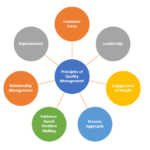
The Principles of Quality Management form the foundation of the ISO 9001:2015 standard and serve as the guiding concepts behind any effective Quality Management System (QMS).
They help organizations improve performance, meet customer needs, and foster a culture of continuous improvement.
This post gives a detailed explanation of each of the seven principles of quality management, the benefits, and how organizations can effectively integrate them into their QMS.
1. Customer Focus
The primary focus of quality management is to meet customer requirements and strive to exceed customer expectations as far as quality of goods and services is concerned.
Every organization depends on its customers. This means understanding current and future customer needs ensures that products and services consistently deliver value.
When customer satisfaction increases, so does loyalty, market share, and profitability.
Key Actions:
-
- Identify and understand customer needs, expectations, and preferences in your particular industry.
-
- Align your organizational goals and objectives with customer requirements.
-
- Measure and monitor customer satisfaction and implement corrective actions when gaps exist.
-
- Anticipate future customer needs and market trends.
Benefits of a Customer-focused QMS:
-
- Increased customer loyalty and repeat business.
-
- Enhanced reputation and brand image.
-
- Sustainable business growth.
2. Leadership
Leaders at all levels helps to establish unity of purpose and direction, and create conditions in which people are engaged in achieving the organization’s quality objectives.
In every organization, strong leadership is vital for creating a culture that values quality. Leaders must communicate the organization’s vision, set a clear strategic direction, and inspire employees to contribute to shared goals.
Leadership fosters trust, collaboration, and accountability across all levels.
Key Actions:
-
- Develop a clear vision and communicate it effectively to all stakeholders.
-
- Create an environment that encourages involvement and innovation.
-
- Empower people through training, trust, and delegation.
-
- Ensure that quality objectives align with the organization’s overall strategy.
Benefits of Leadership in QMS:
-
- Improved alignment of processes and resources.
-
- Greater employee engagement and motivation.
-
- A proactive culture focused on achieving organizational goals.
3. Engagement of People
Competent, empowered, and engaged people at all levels are essential to enhance the organization’s ability to create and deliver value.
When people are fully involved and take ownership of their work, they contribute more effectively to the organization’s success. In a quality management system, engagement of people increases accountability, creativity, and collaboration, resulting in better performance.
Key Actions:
-
- Promote open communication and teamwork.
-
- Provide training, resources, and opportunities for skill development.
-
- Recognize and reward contributions and achievements.
-
- Encourage participation in improvement activities.
Benefits of Engaging the People:
-
- Improved employee satisfaction and retention.
-
- Enhanced innovation and problem-solving.
-
- Stronger alignment between individual and organizational goals.
4. Process Approach
Consistent and predictable results are achieved more efficiently when activities are managed as interrelated processes that function as a coherent system.
Organizations often function as systems of interrelated processes. When these processes are managed as a system, it helps to optimize performance by ensuring that resources are used efficiently and that results are consistent.
Understanding process interactions also helps to identify inefficiencies and opportunities for improvement.
Key Actions:
-
- Define processes with clear inputs, outputs, and responsibilities.
-
- Analyze interactions between processes.
-
- Monitor performance using KPIs and metrics.
-
- Manage risks and opportunities associated with every process.
Benefits of Process Approach in QMS:
-
- Improved consistency and predictability of results.
-
- Reduced waste and resource duplication.
-
- Enhanced efficiency and effectiveness across departments.
5. Improvement
Successful organizations often have an ongoing focus on improvement.
Through continuous improvement, an organization remains agile and responsive to changes in the environment, customer needs, and technology.
It also fosters innovation and helps prevent stagnation, enabling the organization to achieve higher performance levels.
Key Actions:
-
- Set improvement objectives at all levels.
-
- Use tools like PDCA (Plan-Do-Check-Act), root cause analysis, and CAPA.
-
- Promote a culture that values feedback and learning from mistakes.
-
- Monitor and evaluate improvement activities.
Benefits of Continuous Improvement:
-
- Enhanced performance and competitiveness.
-
- Increased ability to adapt to change.
-
- Strengthened organizational resilience.
6. Evidence-Based Decision Making
Evidence-based decision making involves decisions based on the analysis and evaluation of data and information. Such kind of decisions are informed and are more likely to produce desired results.
Quality management decisions should rely on objective evidence rather than assumptions or intuition.
Collecting and analyzing accurate data is therefore necessary to support better understanding of cause-and-effect relationships to enable effective actions.
Key Actions:
-
- Collect reliable and accurate data.
-
- Use appropriate analytical tools and statistical methods.
-
- Ensure data integrity and transparency.
-
- Base decisions on factual evidence and continuous evaluation.
Benefits of Evidence-based Decision Making:
-
- Improved decision quality and effectiveness.
-
- Increased confidence in business operations.
-
- Ability to demonstrate accountability and traceability.
7. Relationship Management
For sustained success, organizations must manage their relationships with interested parties, such as suppliers, partners, customers, and society.
An organization’s performance is often influenced by its relationships with external and internal stakeholders. Building and maintaining mutually beneficial relationships enhances collaboration, trust, and value creation throughout the supply chain and business ecosystem.
Key Actions:
-
- Identify key stakeholders and understand their needs and expectations.
-
- Establish long-term partnerships with suppliers and partners.
-
- Communicate effectively and share knowledge.
-
- Monitor and evaluate relationship performance.
Benefits of Relationship Management:
-
- Improved supply chain stability and collaboration.
-
- Increased stakeholder trust and satisfaction.
-
- Enhanced ability to create and deliver consistent value.
Conclusion:
These seven principles of quality management form the backbone of every effective Quality Management System that aligns with ISO 9001:2015. Together, they provide a structured and holistic approach to managing quality, driving improvement, and sustaining organizational success.
By applying these principles consistently, organizations can align their processes, engage their people, and build a culture that prioritizes customer satisfaction and continuous improvement.
Leadership commitment ensures that everyone understands their role in achieving quality objectives, while data-driven decisions and strong stakeholder relationships create a foundation for long-term and sustainable growth.